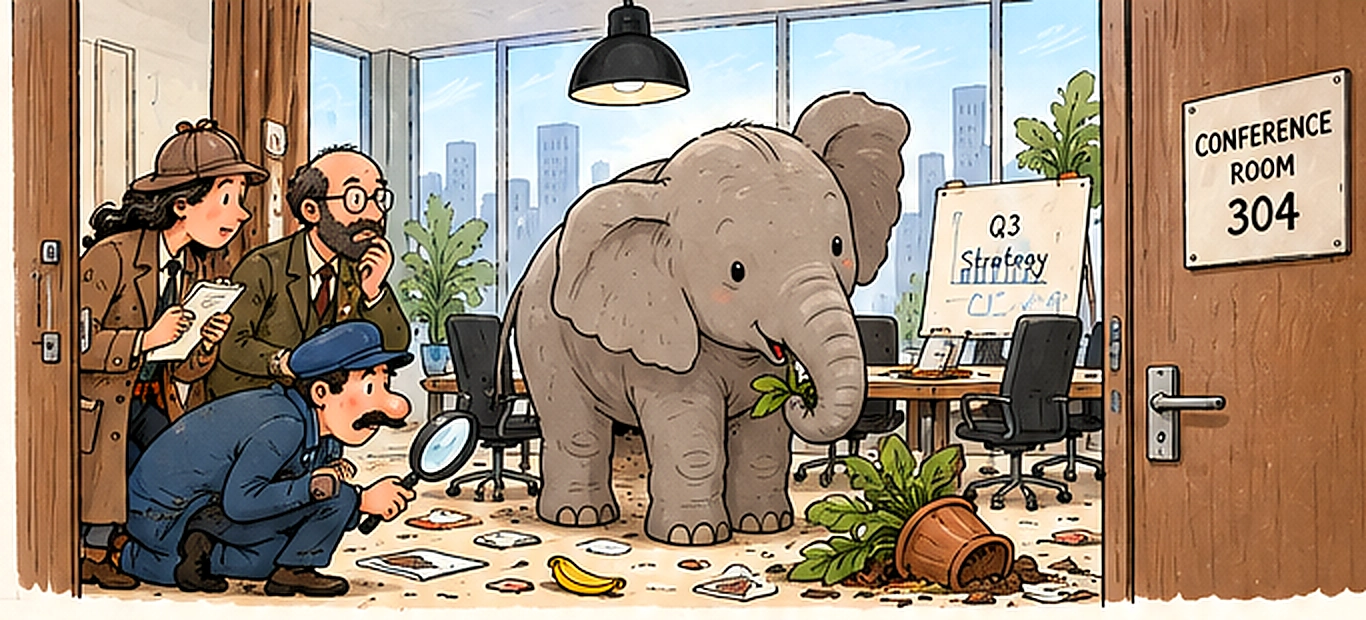
There are three names you hear a lot when people argue about whether marketing worked: attribution, marketing mix modeling (MMM), and incrementality. People ask them the same question, get different answers, and begin arguing even louder. But what if the three were never answering quite the same question?
To understand why they don't, we need to investigate an elephant.
The elephant in Room 304
At seventeen minutes past eight on Monday morning, Nora from Accounts opened the door to Conference Room 304 and found an elephant.
It was a young elephant, gray and round and surprisingly peaceful. It had already eaten half a fern. The other half appeared to be under consideration.
Halcyon House was an ordinary office building, mostly. There were accountants upstairs, consultants down the hall, and a film studio with a green-screen stage on the ground floor. Room 304 was also on the ground floor, although nobody could explain why it was called 304. This had never troubled anyone before.
The windows were shut. The door was undamaged. The receptionist said she had not seen an elephant come through the lobby, and she felt rather strongly that she would have remembered. The manager asked about the carpet.
The animal's handler was contacted, the nearby offices were cleared, and the elephant was kept calm. Then the building manager called three detectives and asked one question: How did she get into Room 304?

Three detectives. Three different habits.
None is incompetent. Each has a particular kind of evidence they trust, and a particular kind of question they know how to answer.
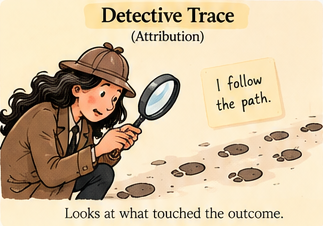
Follows footprints, timestamps, camera footage, and observed journeys. Has never met a sequence she didn't want to reconstruct.
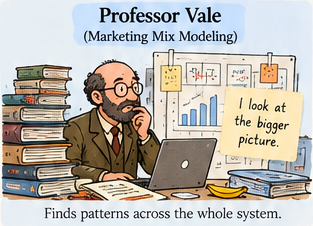
Studies historical records and the building as a system. Can find a pattern in almost anything, including the office coffee schedule.
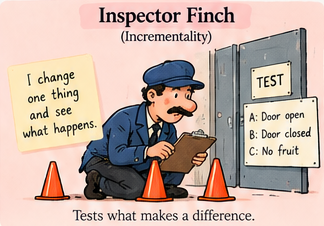
Changes one condition and checks what difference it makes. His clipboard has its own clipboard.
The trail of fruit
Detective Trace knelt beside a muddy footprint. Then another. Then a third. There were camera clips, door records, a cart full of bananas, and a witness who had heard what sounded like a sofa being dragged along the corridor.
She laid the events in a neat line. First the cart came down the corridor. Then the elephant appeared. Then it stopped for the fruit and wandered through the open door. There it was: a trail one could follow with one's finger.
“The catering cart led it here,” she concludes.
Trace wasn't making it up. The fruit had helped lead the elephant into that room. But a trail tells you where someone went. It doesn't always tell you why they were there to begin with.

Attribution follows the observed path. Being on the path to an outcome is not the same thing as causing the whole outcome.
Marketing attribution does something similar: it examines the interactions that led up to a purchase, signup, or other event and assigns credit to touchpoints. Different attribution systems assign that credit differently. But observing a touchpoint, even one that appears just before a conversion, doesn't prove what would have happened without it.
The elegant explanation
Professor Vale glanced at the cart as though it were a very small answer to a very large question. He asked for the building records: deliveries, maintenance, security, the whole untidy history of Halcyon House.
A pattern began to appear. Whenever maintenance crews changed the service routes, strange things tended to happen in the office wing. A lost delivery. An unexpected visitor. Once, a bicycle in the supply closet. And a partition had been opened that very morning.
Vale drew a splendid chart. Every line was straight. Every label was tidy. The building manager liked it so much that, for a moment, he forgot about the elephant.
“Changes in service access explain the incident,” says Vale.
Vale had spotted something important. The opened passage really did matter. Yet his beautiful chart still had a rather large blank space where the reason for the elephant's visit ought to be.
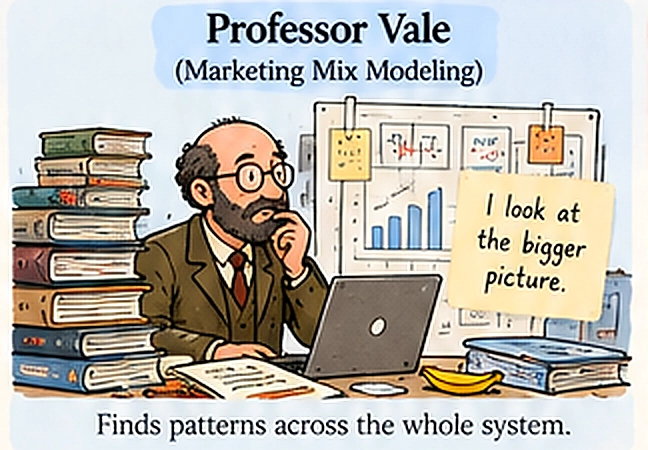
MMM looks for relationships across the bigger system. A convincing explanation of past patterns is not automatically the true causal explanation.
Marketing mix modeling does this with marketing activity and business outcomes over time. It can estimate the contribution of channels to results, provided the data and assumptions support those conclusions. But different explanations may fit historical patterns surprisingly well. Good fit is useful evidence, not a certificate of causal truth.
One question worth testing
Inspector Finch listened to both detectives, tapped his pencil, and asked a smaller question: Could the elephant have reached the office corridor if that partition had stayed shut?
He checked the plans. He walked the two possible routes with the maintenance supervisor. He tested the partition open, then closed. Closed, it blocked the only passage from the studio holding area to the office wing. Open, it let someone through. Someone elephant-sized, even.
That establishes something specific: the partition's open state made this route accessible. It does not prove exactly how the elephant chose to move, and it certainly doesn't explain why the elephant was brought to Halcyon House in the first place.
“Then maintenance caused it?” asks the manager.
“Caused what?” asks Finch.
The manager thought this was an irritating answer. It was also a very good one.
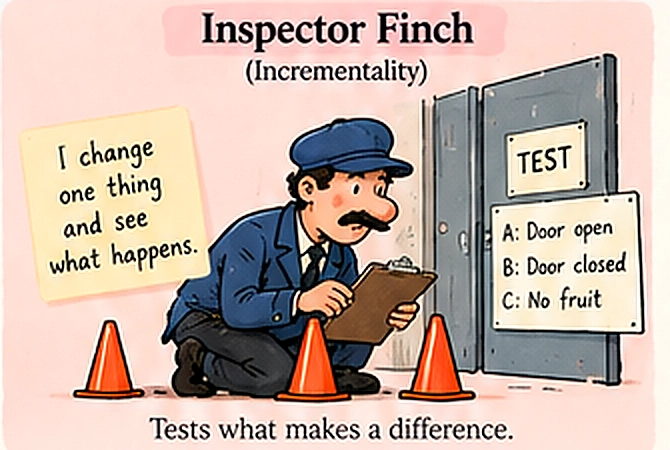
Incrementality asks what difference a specific change made. It can provide strong causal evidence, but only for the outcome and conditions actually tested.
In marketing, incrementality experiments compare outcomes when a marketing activity is changed versus a credible comparison in which it isn't. The goal is to estimate what happened because of the change. A well-designed experiment is powerful. It still has limits: the test may be noisy, short, or specific to one audience, place, or period.
The investigation becomes part of the problem
Trace tapes off a corridor to preserve footprints. Vale asks that the service doors remain unchanged. Finch moves the fruit cart to reconstruct the route. Meanwhile, the elephant's handler is trying to guide her back toward the studio.
They haven't caused the elephant to arrive. But their investigation is now helping explain why she hasn't left.
Somewhere nearby, the elephant is eating the agenda.
The actual story
Just when the detectives had begun comparing notes, the manager's phone buzzed. It was a message from a woman downstairs who had spent the morning looking for her elephant.
The elephant is ours.
Saturday commercial shoot. Green-screen stage. Approved loading-bay entry.
Transport delayed. Elephant held with her handler near the studio. Maintenance opened the internal partition. She followed the catering fruit through an open conference-room door.
We've been trying to guide her back out. Please remove the corridor tape.
She had come to film an insurance advertisement. In the finished commercial, she would stride across the savannah at sunset. On Saturday, she had stood in front of a green wall while a director asked if she could look a little more heroic. She had declined to change her expression.
And that was the mystery. Not a secret tunnel. Not a cunning thief. Just several ordinary things, happening in a most unfortunate order:
- Approved commercial shoot
- Delayed return transport
- Supervised holding near Studio B
- Service partition opened
- Fruit cart in corridor
- Conference-room door open
Trace correctly identified part of the elephant's final path. Vale correctly noticed that service access mattered. Finch established that a closed partition would have blocked the route.
Each had something true. None had the full explanation. And that matters more than deciding which detective “won.”
MMM vs attribution vs incrementality: three different questions
So what did the three detectives teach us? More than they meant to. Their ways of working are much like the three ways marketers try to work out what made something happen.
Attribution: What was on the journey?
Useful for understanding observed touchpoints and paths. But it doesn't, on its own, establish what caused the outcome.
MMM: How does the broader system behave?
Useful for estimating contributions across channels and time. But its causal interpretation depends on what the model can distinguish and which assumptions hold.
Incrementality: What difference did a change make?
Useful for testing causal effects through controlled comparisons. But the result pertains to the specific intervention, population, and period studied.
When the methods disagree, they might genuinely conflict. But sometimes they aren't estimating quite the same thing. Before choosing a winner, ask whether their questions, timeframes, and definitions actually match.
In a simulated world, we can build the whole chain ourselves and know exactly what caused what. Then we can see which methods recover that truth and where they struggle. In real marketing, nobody sends us the full incident report. We have to combine evidence, test assumptions, and remain willing to revise our conclusions.
A parable about partial truths
This story is a playful adaptation of the ancient blind men and the elephant parable, preserved in several South Asian traditions, including Buddhist, Jain, and Hindu tellings.
In familiar versions, several people encounter different parts of an elephant. One feels the trunk and thinks of a snake; another touches a leg and thinks of a tree; another feels its side and thinks of a wall. Each reports something about a real elephant. Each mistakes a limited view for the whole animal.
The lesson is not that everyone gets to invent their own truth. The elephant exists independently of anyone's account of it. The challenge is that each observer sees only part of it.
So it is with attribution, MMM, and incrementality. The goal isn't to crown a permanent winner. It is to know what each method can reveal, what it cannot, and how the pieces might fit together.
By 12:30, the detectives have amended their reports.
Trace updates the timeline. Vale revises the building model. Finch clarifies precisely what his test established.
The handler leads the elephant safely back toward Studio B.
At the exit, the building manager asks, “And who is responsible for the photocopier?”
The three detectives look down the hall. The elephant, who had never been invited to offer an opinion, is already on her way home.
A note on the source: Inspired by the traditional parable of the blind men and the elephant, including the Buddhist Udāna 6.4 and Jain philosophical discussions of partial viewpoints. The office mystery, detectives, and commercial shoot are original fictional devices. Illustrations are AI-generated editorial artwork. This is an approachable introduction, not a substitute for the technical assumptions required to apply measurement methods responsibly.